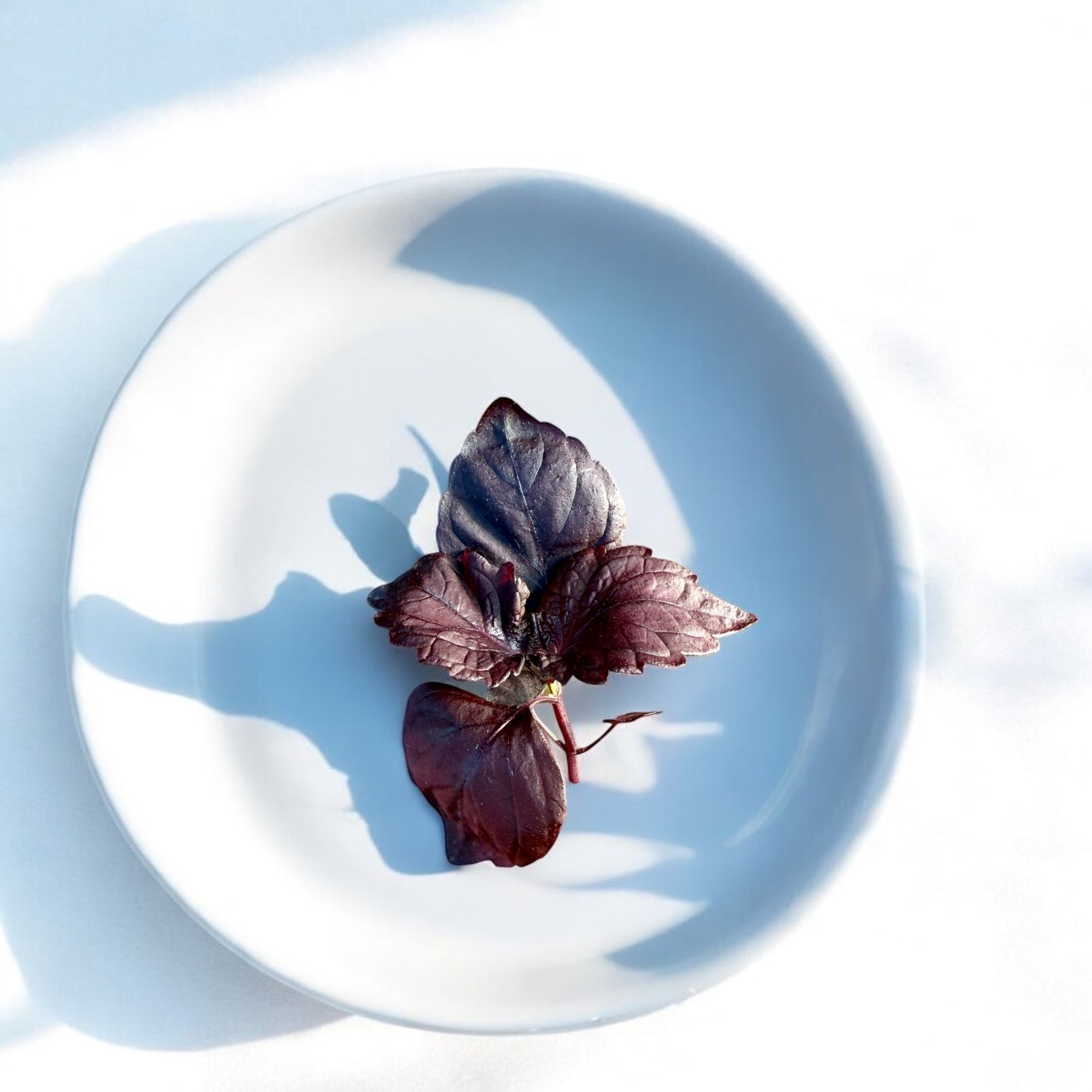
What happens in the fourteen days between a red shiso seed hitting soil in Vaudreuil-Dorion and a finished microgreen landing on a finished plate at Monarque — a day-by-day walkthrough of the grow cycle, the harvest window, and the delivery rhythm that keeps Montreal's best kitchens on their prep schedule.
When a chef at Monarque finishes a seared halibut with three small red shiso leaves at 8:47 PM on a Saturday night, that shiso started its life fourteen days earlier in a flat of soil about forty kilometers west, in a greenhouse that smells like germination and nothing else.
Here's what happens in between.
Day -14 — Seed selection
Red shiso is a slow, deliberate crop. The seed we use is a Japanese cultivar — smaller than a green shiso seed, with a red hypocotyl that shows up as burgundy staining on the emerging stem within seventy-two hours of sowing. We pre-test every new seed lot on a small tray before committing it to production; shiso germination rates can swing from ninety percent to sixty depending on the harvest year, and a bad lot would cascade into two weeks of short deliveries.
Day -13 — Soak and sow
Shiso seeds sit in cool water for twenty-four hours before sowing. The soak breaks the seed-coat inhibitor and evens out germination timing — without it, half the tray would come up on day four and the other half on day seven, and the finished harvest would have two very different plant sizes on the same tray.
Day -12 to Day -10 — Blackout stack
Sown trays go onto the blackout rack, stacked under a weighted tray that keeps contact with the soil and forces the seeds to drive roots down before they send shoots up. For three days there's no light at all. This is the least photogenic part of a microgreen farm and one of the most important — germination is happening, but you can't see anything.
Day -9 — Into the light
Trays come off the blackout rack and onto the light cycle. First glimpse of red pigment. Shiso at day nine is pale pink, almost translucent — the deep burgundy that ends up on the plate hasn't arrived yet.
Day -7 — First true leaves
The cotyledons (seed leaves) have opened and the first true leaf is forming at the center of each plant. This is the developmental stage where shiso transitions from "a sprout" to "a microgreen." Flavor shifts simultaneously: on day seven, shiso tastes grassy and faint. On day nine, the signature cool-mint-anise note starts to land.
Day -4 to Day -2 — Color development
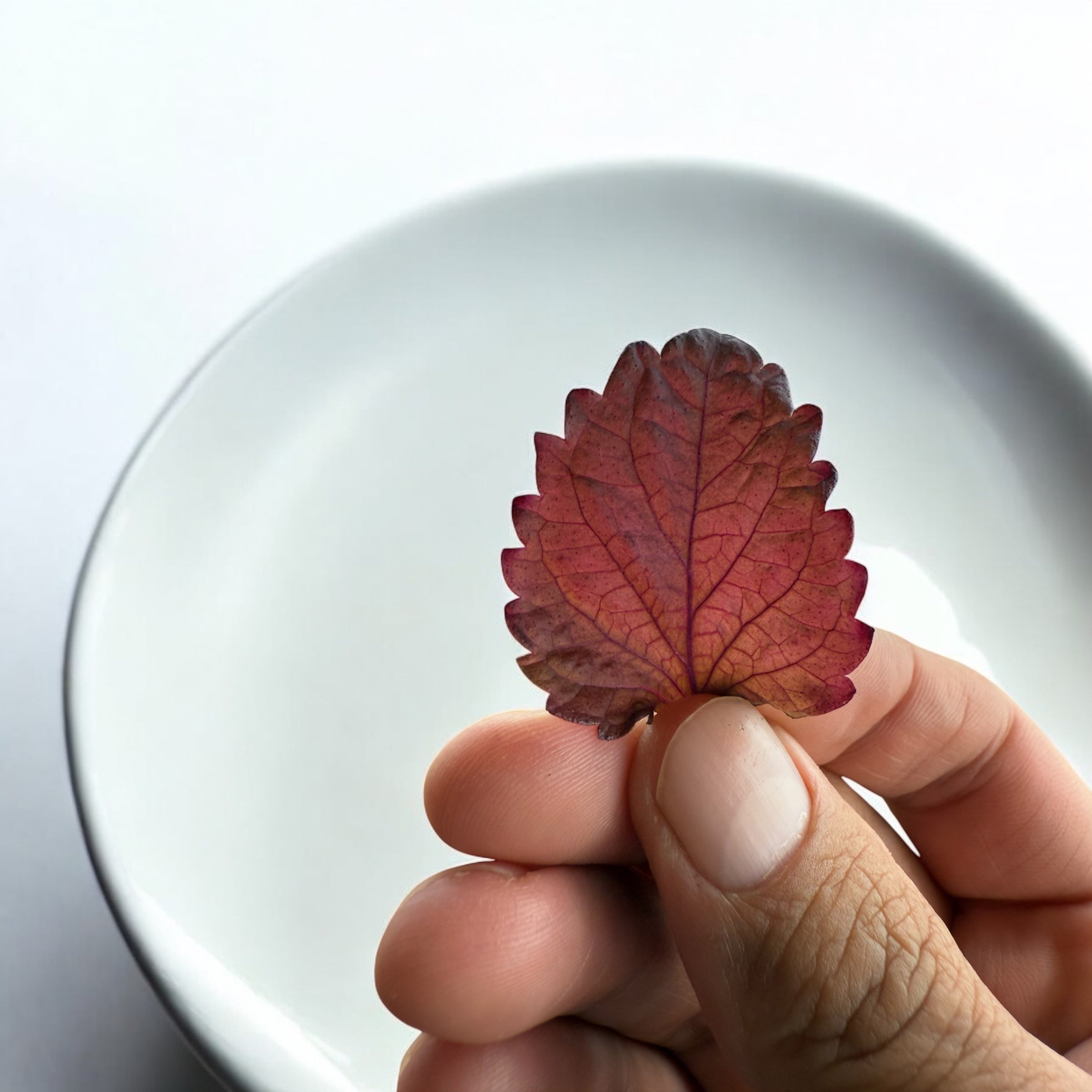
The red is fully in. Trays go from pink-tinged to deep burgundy-veined in about forty-eight hours, depending on light exposure and ambient temperature. We check pigmentation twice daily during this window — a tray that isn't showing full color by day twelve usually means the light cycle is off, and we'd rather correct it now than cut under-pigmented shiso on Friday morning.
Day -1 — Harvest morning
Harvest starts at 5 AM Thursday for Thursday evening delivery — or 5 AM Friday for Saturday delivery, depending on the account. Shiso is cut by hand with a serrated harvest knife, leaf by leaf, not mowed. Machine harvesting bruises shiso; hand harvesting takes ninety minutes per tray and preserves the full cool-mint flavor. Cut greens go directly into single-use clamshells, weighed, labeled, and walked into the cooler at 2°C within fifteen minutes of cutting.
Day 0 — Delivery
Our delivery route runs Thursday afternoons for Vieux-Montréal accounts. Monarque's delivery is typically 2–4 PM — which puts the shiso on their prep shelf in time for the evening service's mise en place. The kitchen logs it in, wipes the clamshell with a damp cloth, and sets it in their herb reach-in at station height.
Day 0 — Service
By 6 PM the kitchen is plating. The shiso that hit the soil fourteen days ago now finishes a seared halibut, a scallop crudo, or a foie gras torchon — whichever composition the kitchen is running that night. Three leaves per plate, placed by hand with tweezers, ninety seconds before the plate leaves the pass.
Why fourteen days matters
The shiso you'd get through a traditional produce distributor was harvested somewhere in California or Mexico, went into a cardboard box on a refrigerated truck, and arrived in Montreal between four and seven days after cutting. By the time it hits the kitchen, it's halfway through its shelf life. The flavor is still there; the texture is softening.
Our delivery cycle compresses that timeline to a single day. Harvest morning, same-day delivery, same-evening service. On a tasting menu that depends on the finishing ingredient being correct, that difference is the difference between a chef buying microgreens and a chef buying commodity greens.
If you run a Montreal kitchen and want red shiso on the same cycle, see the red shiso listing or reach out via the wholesale page to set up a weekly standing order.